H330Fatal if inhaled

The GHS hazard statement for acute toxicity, inhalation, categories 1 and 2. Here is what it means, the label elements that travel with it, and the substances that carry it.
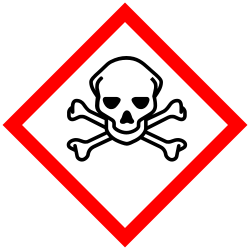
At a glance

Official statementFatal if inhaled.
Hazard classAcute toxicity, inhalation
CategoryCategories 1 and 2
Signal wordDanger
PictogramGHS06 ToxicGHS06Skull and crossbones

What it means

Serious harm from breathing the substance — as gas, vapor, dust, or mist — over a single short exposure. Categories are set from acute toxicity estimates (ATE) per GHS Chapter 3.1.

Precautionary statements paired with H330

When the engine writes SDS Section 2 or a container label for a product carrying H330, these are the P-codes it assigns, in the official Annex 3 groups:

PreventionP260Do not breathe dust/fume/gas/mist/vapors/spray.
P271Use only outdoors or in a well-ventilated area.
P284In case of inadequate ventilation wear respiratory protection.
ResponseP304IF INHALED:
P310Immediately call a POISON CENTER or doctor.
P320Specific treatment is urgent (see first-aid instructions on this label).
P340Remove person to fresh air and keep comfortable for breathing.
StorageP403Store in a well-ventilated place.
P405Store locked up.
DisposalP501Dispose of contents/container in accordance with local/regional/national/international regulations.

Substances that carry H330

17 of the 4,225 substances in our database carry H330 when classified in pure form — recognizable examples:

  • (3E)-dec-3-en-2-one — CAS 18402-84-1
  • 1,2-benzisothiazolin-3-one — CAS 2634-33-5
  • allyl methacrylate — CAS 96-05-9
  • barium diboron tetraoxide — CAS 13701-59-2

Same hazard class: H331 · H332 · H333

Reference information, not legal or professional advice. Statement texts and allocations follow GHS Rev 9 / 29 CFR 1910.1200 Appendix C as implemented by our classification engine; the regulatory text and agency practice control. Claims last reviewed July 23, 2026.

The engine writes these for you.

When SDS HQ authors an SDS or a container label, it assigns the hazard statements, signal word, pictograms, and precautionary statements from these same tables — automatically, with the calculation shown.