Author your own OSHA-compliant SDSs with a real GHS mixture engine

Most "SDS software" fills in a template and leaves the hazard calls to you. SDS HQ is different: it classifies your mixture from its actual composition using the GHS calculation rules OSHA adopted, then writes a complete, defensible 16-section safety data sheet around that classification.

What SDS authoring is

Authoring a safety data sheet means producing the 16-section document that OSHA’s Hazard Communication Standard (29 CFR 1910.1200) requires for every hazardous chemical you manufacture, import, or distribute. The hard part is not the formatting — it is the classification: deciding, from the ingredients and their concentrations, which physical, health, and environmental hazard classes and categories apply, and therefore which signal word, hazard statements, precautionary statements, and pictograms the sheet must carry.

SDS HQ handles both halves. You enter your product’s components and their weight percentages; the engine classifies the mixture; and the tool assembles the full sheet — identification, hazards, composition, first aid, firefighting, handling and storage, exposure controls, physical properties, stability, toxicology, ecology, disposal, transport, regulatory, and other information — with the classification results flowing into every section that depends on them.

Why it matters for compliance

Under HazCom 2024 (aligned to GHS Revision 7), a downstream employer relies on your SDS to protect workers and to build their own labels and training. If your classification is wrong, the error propagates: the wrong pictogram goes on the drum, the wrong precautions reach the person handling it, and the liability traces back to whoever authored the sheet.

A template-only tool cannot catch that, because it never actually classifies — it just types what you tell it. An engine that computes the classification from composition gives you a sheet you can defend, and a consistent basis you can re-run whenever a formulation or a rule changes.

How SDS HQ does it

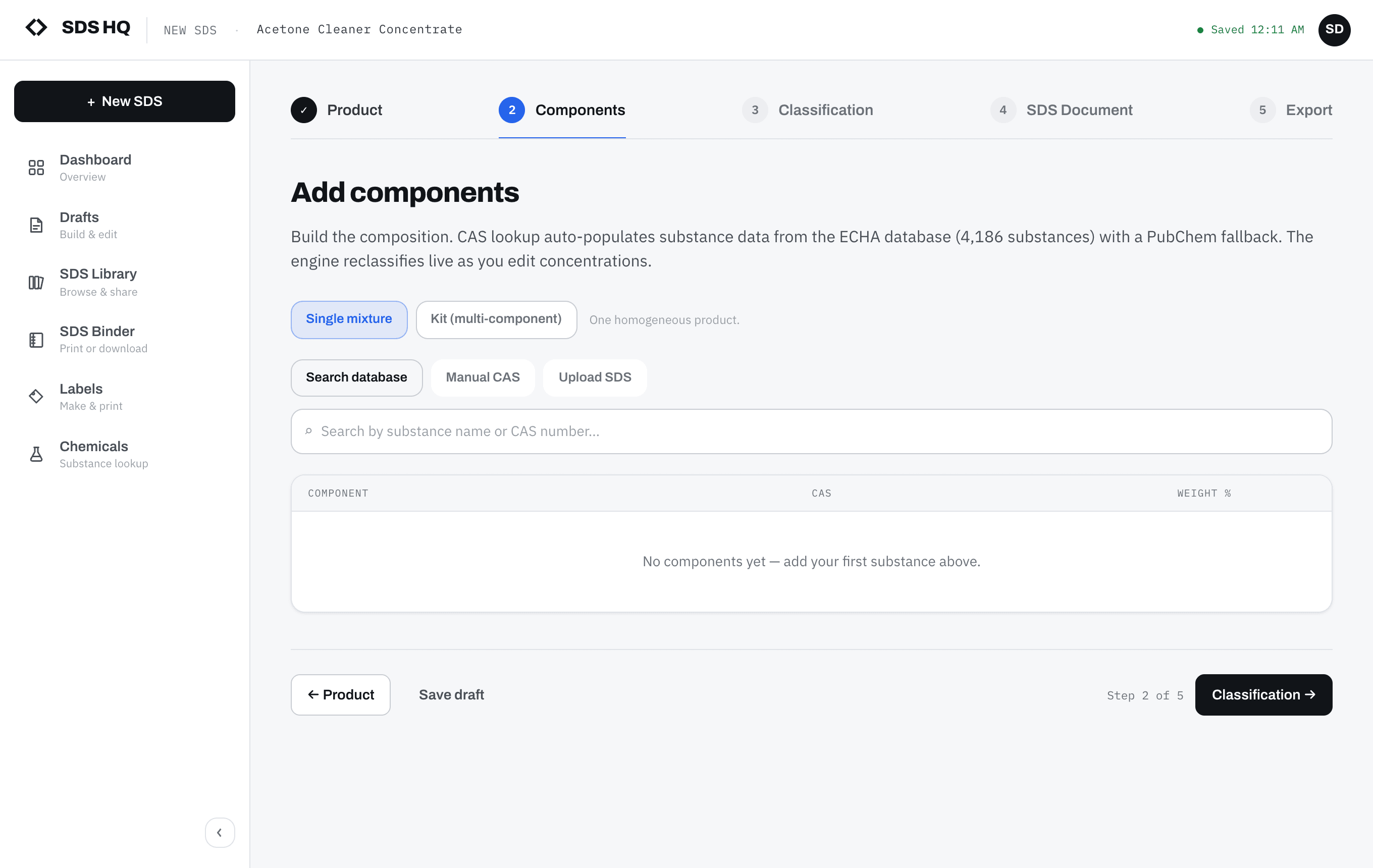
The SDS HQ authoring wizard on the Add components step, showing CAS-lookup search and the five-step Product / Components / Classification / SDS Document / Export flow
The authoring wizard — CAS lookup pulls substance data from the ECHA database, and the engine reclassifies live as you edit concentrations.

The classification is first-principles, not a lookup of pre-canned products. For each hazard class the engine applies the GHS mixture rules directly:

  • Health hazards (acute toxicity, skin/eye irritation and corrosion, sensitization, carcinogenicity, and the rest) are computed with additivity formulas, ATE mixing, and the GHS cut-off and concentration limits — drawing hazard data for each ingredient from a curated substance library.
  • Physical hazards that genuinely require measured data (flammability, oxidizing potential) are gated: the engine will not invent a category it cannot support, and tells you what test data it needs.
  • GHS bridging principles are applied where the data supports them, so a close variant of a classified mixture can inherit an assessment instead of starting from zero.
  • The resulting signal word, H-statements, P-statements, and pictograms are derived from the classification, so Section 2 of the sheet always matches the hazards the engine actually found.

You keep full control. An author can override any hazard determination, but the tool requires a written basis for the override and records it on the sheet, so the reasoning travels with the document. Multi-component "kit" products are supported too, with each component classified independently and grouped correctly across the shared sections. Every finished SDS carries the engine version that produced it, and the tool flags when a published sheet has drifted from its source formulation so you know when a revision is due.

Finished sheets export to both PDF and editable Word, publish into your searchable library, and carry automatic whole-number revision control. The classification methodology — every rule, data source, and known limitation — is documented in full, because a sheet is only as trustworthy as the reasoning behind it.

Plans

Available on Author and Author Plus. One-off authoring is $49 per SDS. Compare plans →

Store and share your SDSs free

Hosting your library and reading sheets is free forever. Add locations, teams, and authoring as you need them.