H224Extremely flammable liquid and vapor

The GHS hazard statement for flammable liquids, category 1. Here is what it means, the label elements that travel with it, and the substances that carry it.
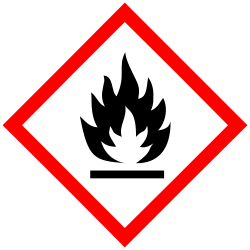
At a glance

Official statementExtremely flammable liquid and vapor.
Hazard classFlammable liquids
CategoryCategory 1
Signal wordDanger
PictogramGHS02 FlammableGHS02Flame
CriteriaFlash point below 73.4 °F (23 °C) and initial boiling point at or below 95 °F (35 °C) — GHS Table 2.6.1.

What it means

Liquids whose vapor ignites readily. Categories run from 1 (most flammable) down to 4, set by flash point — the lowest temperature at which the liquid gives off ignitable vapor — together with initial boiling point.

Precautionary statements paired with H224

When the engine writes SDS Section 2 or a container label for a product carrying H224, these are the P-codes it assigns, in the official Annex 3 groups:

PreventionP210Keep away from heat, hot surfaces, sparks, open flames and other ignition sources. No smoking.
P233Keep container tightly closed.
P240Ground and bond container and receiving equipment.
P241Use explosion-proof electrical, ventilating, lighting equipment.
P242Use non-sparking tools.
P243Take action to prevent static discharges.
P280Wear protective gloves/protective clothing/eye protection/face protection.
ResponseP370In case of fire:
StorageP403Store in a well-ventilated place.
DisposalP501Dispose of contents/container in accordance with local/regional/national/international regulations.

Substances that carry H224

14 of the 4,225 substances in our database carry H224 when classified in pure form — recognizable examples:

  • di-methylamine — CAS 124-40-3
  • ethanal — CAS 75-07-0
  • ethanethiol — CAS 75-08-1
  • ether — CAS 60-29-7

Same hazard class: H225 · H226 · H227

Reference information, not legal or professional advice. Statement texts and allocations follow GHS Rev 9 / 29 CFR 1910.1200 Appendix C as implemented by our classification engine; the regulatory text and agency practice control. Claims last reviewed July 23, 2026.

The engine writes these for you.

When SDS HQ authors an SDS or a container label, it assigns the hazard statements, signal word, pictograms, and precautionary statements from these same tables — automatically, with the calculation shown.